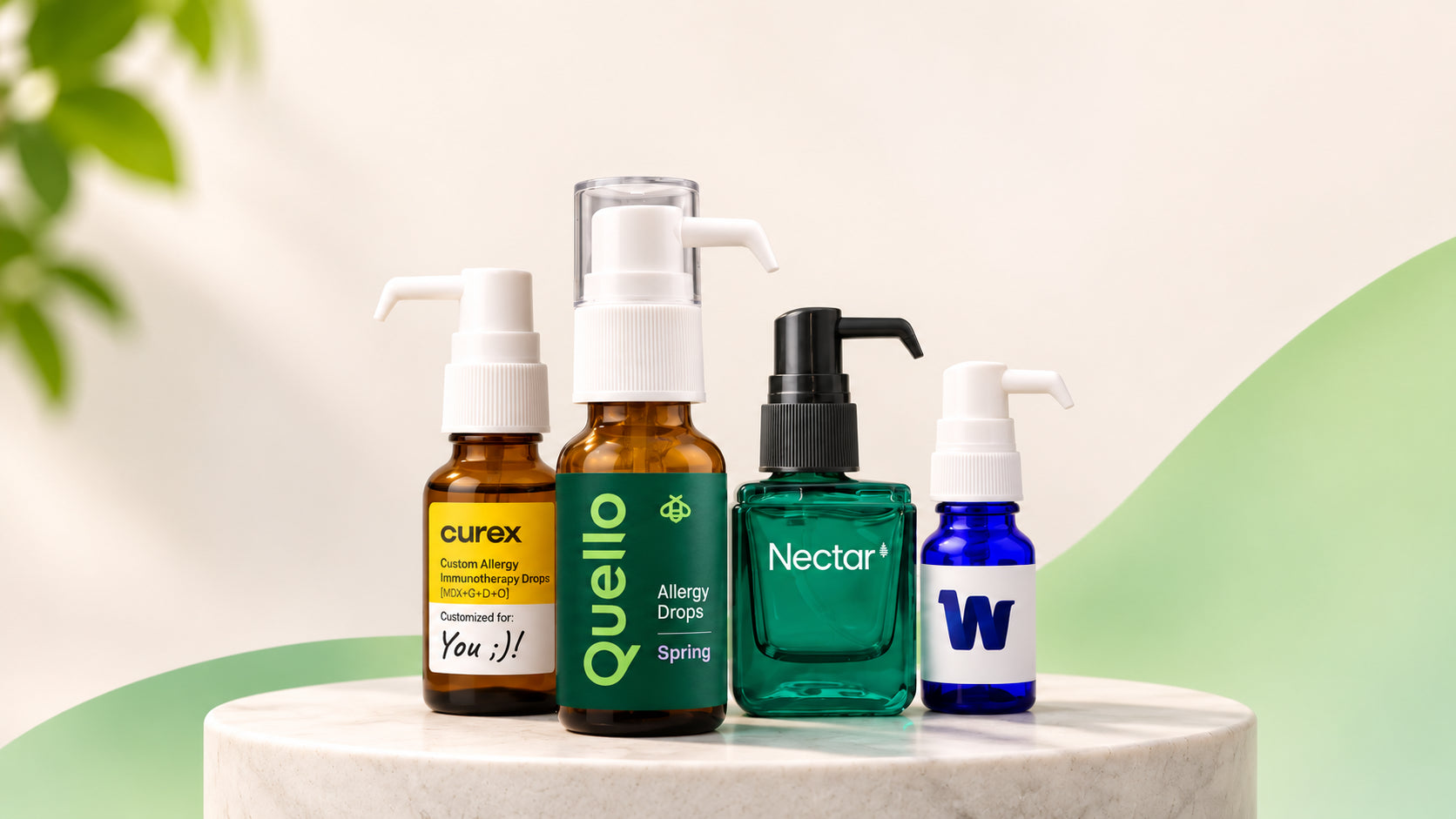
Are All Allergy Drops The Same?
Are all allergy drops the same? What’s in the bottle, how the dose is chosen, and who follows your progress can make all the difference. Learn what to ask before choosing a provider and why the monthly price tells only part of the story
A few times every year, somebody in the middle of a consultation with us pulls out their phone and texts me a photo. It's the label on their current bottle of allergy drops, prescribed by another company, and the question is always some version of the same one: how do these drops compare to what you'd be giving me?
These are people seeking a second opinion, usually because their current follow-up felt thin or their overall improvement felt slow, and it's a completely fair question.
Here's the uncomfortable part. I usually can't answer it. Not because I'm withholding anything, but because the label won't let me. Sometimes it lists the allergens with no amounts at all. Sometimes it lists amounts, but in units that don't convert to anything else, so there's no honest way to say whether that bottle is stronger, weaker, or roughly the same as ours. I cannot rank two bottles by their labels, and neither can anyone else, no matter what they tell you.
The short answer: no, allergy drops are not all the same. Bottles differ in which allergens they contain, how much of each, how those choices were made, and how the dose gets adjusted once you're on them. And because most of the underlying extracts are not standardized, the label can't settle any of it.
This article explains where that mess comes from, what the research actually shows about doses and dosing, and the questions that get you real answers when a label can't, from any provider, including us.
One more thing before we dig in, so you know who's talking. I've used allergy drops since 2003 and treated allergies since 1991, and in that time our practice has put more than 15,000 patients on drops. If those years have taught me anything about this subject, it's that dose and dosing in liquid drops don't have the tidy answer the labels imply, and the people who claim otherwise are the ones to be careful with.

What's actually in the bottle
Allergy drops are allergen extracts, the same FDA-licensed extracts used to mix allergy shots, suspended in glycerin, which preserves them and gives the drops their bittersweet taste. That part is common to everyone in this field. The differences start with the word that should settle everything and doesn't: potency.
A minority of US allergen extracts are standardized, meaning the FDA requires each batch to fall within a defined potency range measured against a reference. As of 2021, only 18 US extracts were standardized: cat, the dust mites, a handful of grasses, short ragweed, and the stinging-insect venoms. (1) Everything else, which includes most trees, most weeds, the molds, and dog, is non-standardized.
For those, the label describes how the extract was made, weight-to-volume ratios like 1:20, or protein-content units, none of which certify how allergenically potent the result is. Two vials of the same non-standardized extract, made the same way, can differ meaningfully in actual potency. (2)
Then there are the units themselves. Standardized extracts are labeled in bioequivalent allergy units (BAU) or allergy units (AU). Non-standardized ones use weight-to-volume or protein nitrogen units. The European liquid products in the research literature use their manufacturers' own index-of-reactivity units. The FDA-approved tablets use others still. None of these convert into anything that allows them to be compared to one another.
So, when a patient texts me a label reading 1:20 w/v for one allergen and 10,000 BAU for another, and asks how it compares to a bottle labeled differently, the truthful answer is that no one on earth can do that math, because it isn't math. It's apples to alphabets.

Where the dose numbers came from in the first place
When I started prescribing sublingual drops in 2003, there was very little in the literature about how to formulate them, and almost nothing about how to translate a patient's allergy test into a starting dose. The small number of us doing sublingual immunotherapy in the US at that time mostly did the sensible thing: we borrowed what we knew from allergy shots, which had decades of accumulated practice behind them, even if the shot doses themselves had never been pinned down by modern trials either.
The tradition I trained in, the otolaryngic allergy tradition (ENT allergy), had one tool that mattered here: skin endpoint titration, a testing method going back to Herbert Rinkel's work in the early 1960s. (3) Instead of testing each allergen at a single concentration and getting a yes-or-no answer, titration tests a series of dilutions and finds the point where your skin starts reacting. It answers not just whether you're allergic to something, but roughly how allergic you are to it. (3,4) That number matters for dosing, because a single-concentration test tells you nothing about severity, and when you don't know severity, safety forces you to start treatment at a very low level and build up from there, slowly. With a titrated endpoint, you can begin at a dose calibrated to that particular patient, letting you safely pick a higher starting dose.
Suggested reading: Skin Test vs. Blood Test for Allergies: Which Is Right For You?
Even skeptical third parties describe endpoint titration as a valid way to set a safe starting dose for immunotherapy, and my academy published its formal testing strategy along these lines in 2003. (5)
I'll be careful about what that tradition proved and what it merely argued. The method is documented. The claim our meeting presenters always attached to it, that starting stronger gets patients to relief sooner, was reasoning, not trial data, and the one controlled study of titration-based immunotherapy was tiny, ten completers. I believed the reasoning then and I believe it now, with one adjustment: the original logic was built around shot safety, where the fear is anaphylaxis.
Drops carry a far smaller systemic risk. So, for drops, the real value of knowing how allergic you are isn't mainly about avoiding danger. It's about not spending your first year at a dose weaker than it needed to be. That is my judgment, formed from practice, and I'm labeling it that way on purpose.
From 2003 onward, that's how our dosing evolved: an inherited shots-style starting framework, then twenty-plus years of adjusting it, patient by patient, against three things we could actually watch: side effects, how people responded, and what the pollen counts in our region were doing. What we put in the bottles, how many allergens we'd combine, which ones could share a vial, all of it was refined the same way. That is experience, not a controlled trial, and I'd rather tell you so than dress it up.

Then the tablets changed the conversation
The first genuinely rigorous dose-finding work in sublingual immunotherapy came from the tablet programs, the products that eventually won FDA approval for grass, ragweed, and dust mite. These were real dose-ranging trials. The five-grass tablet, for example, was tested at three strengths in its pivotal dose-finding study, and the middle dose won: the highest dose added nothing over it. (6) The doses that emerged from these programs were, by most reckonings, much higher than what typical multi-allergen liquid drops had been delivering.
And almost overnight, those became the numbers everyone quoted. The conference discussions changed. The tablet doses started being treated as the benchmark for all sublingual treatment, including liquid drops the tablet trials had never tested.
I want to lay out, as plainly as I can, why that reasoning never sat right with me.
Before the tablets, the liquid multi-allergen literature had already been tested against placebo, extensively. A Cochrane systematic review pooled roughly 60 randomized, double-blind, placebo-controlled trials and found significant reductions in both symptoms and medication use. (7) Direct comparisons, including a meta-analysis of 50 pediatric studies covering 10,813 children, have found no significant efficacy difference between allergy drops and allergy shots, with far fewer adverse events on the sublingual side. (8)
Meta-analyses restricted to liquid drops specifically reach the same conclusion: the liquid form works. And those positive liquid trials were run mostly at doses well below what the tablets later established for themselves. (9)
How much below, and how scattered? A comprehensive review counted 57 sublingual studies that reported doses in micrograms of major allergen. The individual doses across them varied 35,000-fold. Monthly cumulative doses ranged from a small fraction of a typical shot regimen to more than 500 times one. (10) And for most of those studies, the authors offered no justification at all for the dose they picked.
The World Allergy Organization's position papers, which reviewed this whole body of work, put the resulting confusion bluntly: positive and negative results have been obtained at both low doses and high ones. (11, 12)
So here is the logical problem with the benchmark that took over. A dose proven effective for product A is not a minimum effective dose for product B. The tablet trials established what their tablets need. They never tested liquid multi-allergen drops at any dose, high or low. Sixty positive placebo-controlled trials don't get retroactively cancelled because a different product, tested by itself, landed on a bigger number. Yet the field started talking as if they had been.

Suggested reading: How to Read & Understand Literature About Allergy Treatments
Why one bottle says once a day and another says three times
The same openness explains something patients notice when they compare notes: protocols differ everywhere. Some providers dose once daily, some more often. Some walk you up through escalation vials over weeks; some start you at maintenance strength on day one. None of this is arbitrary, and none of it is settled either. The protocols descend from different corners of a research literature that never converged.
What we do know is reassuring: small trials that skipped the build-up phase entirely and started patients directly at maintenance found no meaningful increase in side effects, and across the literature, side effects cluster in the first days to weeks, are overwhelmingly local, mouth itching and the like, and usually fade without any change in dose. (11,12) When two legitimate providers hand you two different schedules, you are not looking at one right answer and one wrong one. You're looking at two inheritances from an unfinished science.
Mixed for you, or mixed for your region?
There's one more difference between bottles that no label will show you, and it may matter more than any of the above: how the contents were chosen.
Nearly all of the published multi-allergen drop research was done one way. The patient was tested, a history was taken, and the preparation was formulated for that individual, containing only the allergens their testing and history pointed to. Trials went so far as to exclude people who weren't sensitized to the study allergen before randomizing anyone.
That is also what the everyday American allergy shot has always been: an individual formulation built from your results. And it's what my own academy's 2024 clinical practice guideline on immunotherapy calls for, recommending that treatment be limited to clinically relevant allergens, the ones connected to your history and confirmed by your testing. (13)
A pre-made standard mixture, built around a region rather than a person, is a different thing. I'm not going to tell you it doesn't work, because I don't know that, and neither does anyone else: it simply hasn't been studied the way individualized preparations have. What I can tell you is the shape of the evidence.
The strongest trials in this field are single-allergen standardized products, the tablets. The multi-allergen liquid literature is thinner but real, and it uses individually formulated preparations. A standard regional mix is a third thing, less studied than either. Those three are not interchangeable, and a company describing its product with the vocabulary of one while selling another is answering a question you didn't ask.
I should include the concession that has to travel with every efficacy discussion in this field, ours included: the very best evidence, the kind that wins FDA approval, belongs to single-allergen tablets, and no tablet exists for the main springtime allergen, trees. The individualized multi-allergen approach that we and the aqueous literature use rests on a real but smaller trial base, plus long practice.
That gap is a fact about research funding as much as about biology, but it's a gap, and you should hear it from the people treating you.
Which brings me to the single most useful question in this entire article, one any patient can ask any provider, including us: was this bottle formulated from my test results and my history, or is it a standard formula? It isn't an accusation. It's an information question with a short factual answer, and how a company handles it will tell you a great deal.

Suggested reading: What I got wrong in 35 years treating allergies
What the monthly price can and can't tell you
Now the question that probably brought you here: if one company charges a fraction of what another charges, is it the same treatment at a better price?
After everything above, you can see why a monthly number can't answer that.
Two subscriptions at very different prices may differ in how many allergens are in the bottle, at what concentrations, in how big the bottle is and how long it lasts, in whether escalation vials are included, in whether the physician visits and dose adjustments that keep the treatment on track are inside the number or billed around it, and in whether the contents were formulated for you at all. A cheaper bottle might be a genuinely better value.
It might also simply contain less, fewer things, chosen less specifically, with less attention attached. The price alone cannot distinguish these, and neither can the label. What distinguishes them is answers.

So ask, before you pay anyone, including us:
1. Which allergens will be in my bottle, and why those? The answer should trace back to your testing and your history, not to your zip code.
2. How was my starting dose chosen? There may be more than one defensible answer, but there should be an answer, and whoever gives it should be able to explain it to you in plain words.
3. What are the actual contents and amounts, in writing? You may not be able to compare units across companies, for the reasons above, but a provider should never hesitate to show you what you're taking.
4. What happens if I have side effects, or no improvement by the point you told me to expect it? Who adjusts the dose, how fast, and does that cost extra?
5. Is follow-up with the actual prescriber included in the price, and how often? A multi-year treatment without built-in attention is a bottle, not care.
On cost itself, one plain fact and one honest catch. Drops are nearly always paid in cash, because off-label treatments don't get insurance coverage, and cash has a real upside: you see the entire price before you commit, and you can judge the value against it, which is exactly what insurance in the middle tends to obscure.
The catch: for someone with strong coverage and a met deductible, a covered option like shots or tablets can genuinely cost less out of pocket. Both things are true, and we've written a separate piece that walks through the arithmetic.

What we do, and what I won't claim
Our approach is the one I've been refining since those early years: test, take the history seriously, formulate the bottle for the individual patient with the allergens their results and story support, start as strong as the testing and tolerability allow so the road to benefit isn't longer than it has to be, and then watch, adjusting when the side effects or the response say so. Every part of that is visible to the patient, and every part of it has a reason I can explain.
Here's what I won't claim: that our dose is proven optimal. It isn't, and nobody selling liquid allergy drops can honestly say theirs is, because the study that would prove an optimal liquid dose has never been run. What I can say is narrower and, I think, worth more. Ours is the method the published literature actually used.
It's what my academy's current guideline points to. And it has been continuously adjusted against real outcomes in one practice, under one physician, since 2003. In a field where the dose question is open, the thing you're really choosing is not a number on a label you can't read anyway. It's whether anyone is paying attention to how the number is working in you.
The right next step, if any of this describes you, is an evaluation, not a purchase. Sometimes the honest end of an evaluation is a tablet, or shots with a local allergist, or an office where someone can examine you in person. When that's the answer, it's the one you'll get.
A note to close
At Quello, the question of what's actually in the bottle is close to the center of why we practice the way we do. We're a doctor-led allergy practice, born from the heritage of Advanced ENT & Allergy Center in Colorado, and we treat allergies from home with allergy drops at the center of what we do.
Since 2003, our practice has treated more than 15,000 patients with allergy drops, and I've been the one physician here through all of it, long enough to know that the dose that matters is the one calibrated to you and watched over time, not a number borrowed from a different product.
What we work toward, for the people it fits, is what we think of as allergy freedom, a life where your allergies, and your allergy medicines, stop setting the terms.
And if you want to think it through, we are here for you, wherever you are.
Frequently asked questions
Are all allergy drops the same?
No. Bottles from different providers can differ in which allergens they contain, how concentrated each one is, whether the mix was formulated from your individual test results or from a standard formula, and how the dose is adjusted over time. Because most US allergen extracts are not standardized, and because the potency units in use don't convert to one another, the labels can't be compared directly, even by a physician.
The strongest evidence in this field belongs to single-allergen FDA-approved tablets; multi-allergen liquid drops rest on a smaller but real body of trials, nearly all of which used preparations formulated for the individual patient. If you're comparing providers, compare answers, not labels: ask what will be in your bottle, why, and who will adjust it.
Why do allergy drops cost different amounts from different companies?
Because the products and the care around them genuinely differ. A monthly price can hide differences in how many allergens are in the bottle and at what strengths, how long a bottle lasts, whether the mix was made for your specific test results, and whether physician follow-up and dose adjustments are included or billed separately.
A lower price can be a better value, or it can simply be less treatment with less attention attached; the number alone can't tell you which. Since drops are paid in cash, you can at least see the full cost before committing, which is worth using: ask each provider what's in the bottle, how your dose was chosen, and what follow-up is included, and compare those answers.
How do I know if my allergy drops are strong enough?
You usually can't tell from the label, and you should be skeptical of anyone who claims a label proves it. Published sublingual trials have succeeded and failed at both low and high doses, individual doses across studies have varied enormously, and the dose-ranging study that would define an optimal strength for multi-allergen liquid drops has never been done.
The FDA-approved tablets have proven doses, but only for themselves, one allergen at a time. In practice, strength is judged clinically: whether your symptoms and your need for allergy medicines are declining over the first nine to twelve months, and whether your prescriber adjusts the dose when they aren't. The useful question isn't the number on the bottle; it's who is watching your response and what they'll do about it.
What should I ask before starting allergy drops?
Five things, of any provider, including us. Which allergens will be in my bottle, and why those? The answer should come from your testing and history. How was my starting dose chosen? What are the contents and amounts, in writing? What happens if I have side effects or no improvement on the timeline you've given me, and does adjusting cost extra?
And is follow-up with the actual prescriber included in the price? None of these questions has one universally right answer, because the underlying science leaves real room for judgment. But every legitimate provider can answer all five plainly, and a company that can't, or won't, has told you what you needed to know.






Overcome your allergies at home with our doctor-led therapy.
Get started with our free allergy test kitGet Started with no test needed.
Overcome your allergies at home with our doctor-led therapy.
Get started with our free allergy test kitGet Started with no test needed.