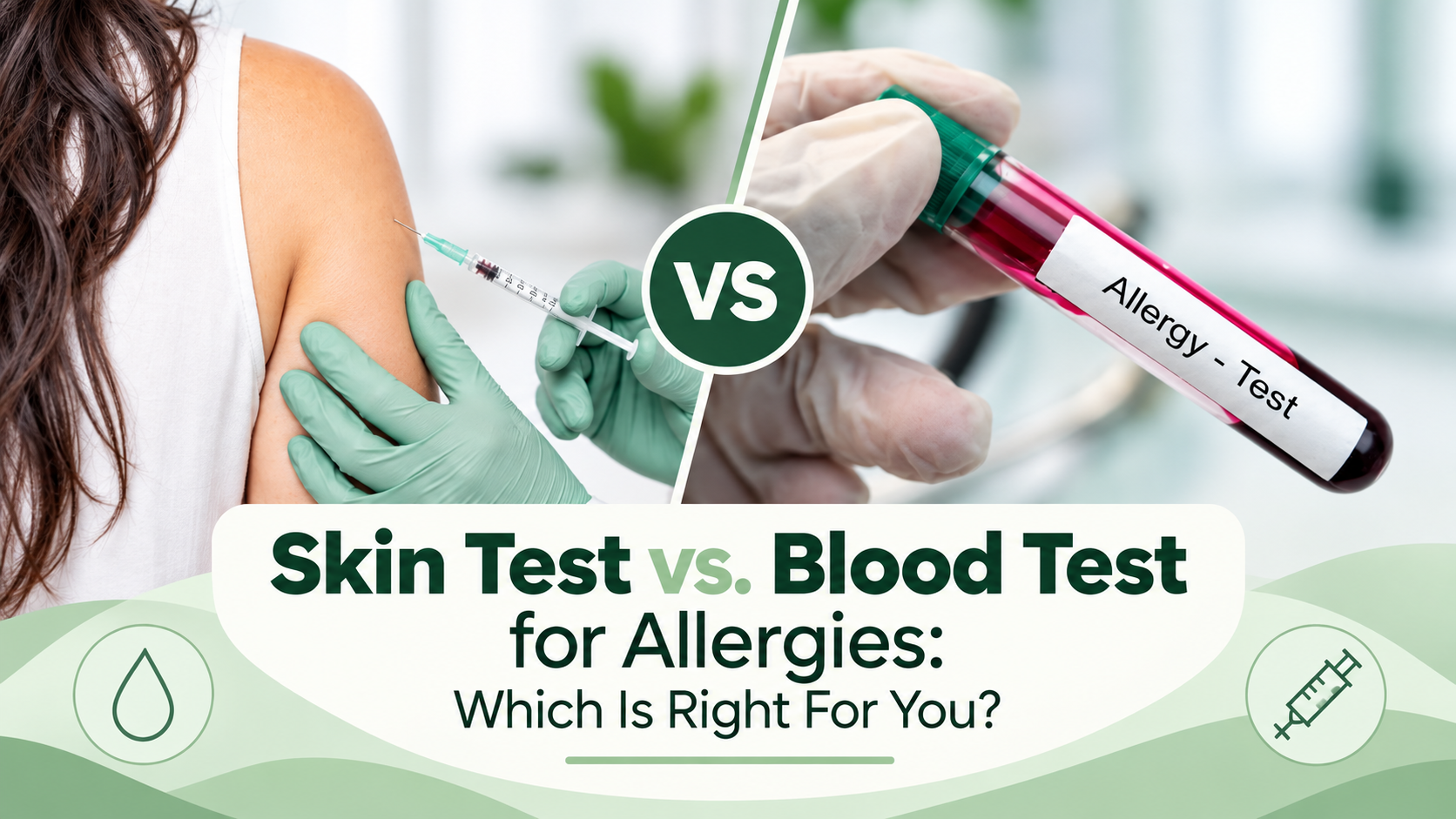
Skin Test vs. Blood Test for Allergies: Which Is Right For You?
Skin and blood allergy tests both look for allergen-specific IgE, but they differ in convenience, preparation, and testing experience. This article will explain how each works and help you choose the option that best fits your symptoms, medications, and lifestyle.

This article is based on an interview with Dr. Michael Menachof and was edited by the Quello editorial team for clarity and consistency with the blog’s style.
Both skin and blood tests are looking for the same thing: a substance called allergen-specific IgE, which is the “fingerprint” your immune system leaves when it has decided to react to something. A skin test looks for it on your skin; a blood test looks for it in a tube.
Both tests are accurate. For most people with the usual itchy eyes and runny nose, the choice between them comes down to convenience and circumstances, not to which one is right.
What matters far more than the type of test is testing for the right things and having someone read the result against your actual history. A list of positives is not a diagnosis. It is the start of one.
In 35 years treating allergies, 23 of those years using allergy drops, this is a question I get all the time, usually right after someone has decided to finally find out what they are reacting to. One boundary before we dive into comparisons.
I am talking about inhalant allergies here: the pollens, dust, molds, and animal dander behind most itchy, sneezy, congested misery.
Food allergy is different and much more complicated, with several different molecules that can drive a single person's reaction and a whole separate set of testing decisions.
For the airborne allergies most people ask about, the picture is cleaner because it really does come down to IgE.
Blood Test vs. Skin Test Comparisons
How Each Test Works
In a skin prick test, a provider places drops of different allergen extracts on your skin, usually the forearm or back, and makes a tiny prick through each one. If you are allergic, a small itchy welt rises at that spot within about 15 to 20 minutes, like a mosquito bite, and they measure it.
A skin prick test is quick, inexpensive, and lets you screen for many allergens at once. It also, by design, makes an allergic person itch, swell, and redden while you sit there, which is not nothing, and I will come back to that.
For a blood test (the specific IgE test), a single sample is taken and analyzed allergen by allergen to measure how much allergen-specific IgE is in your blood, with the results reported as numbers.

Time to Results
You get answers the same day with a skin test, which matters if you are about to start allergy shots and need to move quickly.
Blood test results typically take a few days.
Accuracy & Reliability
Let me be fair about skin testing, because it is a good test. It has been the traditional gold standard for inhalant allergy for a long time; nearly every allergist is trained on it, and for most of the history of this field it was simply the only real option.
In experienced hands, it is sensitive and reliable. If anyone tells you skin testing is outdated or bad, they are overselling. It is neither.
I saw the imperfection often enough in my own office. A patient would come in with a textbook allergic history and exam; we would skin test them, and the result would come back negative. Two weeks later, we would repeat it, and it would be clearly positive. The allergy had been there the whole time; your skin just wasn't reactive that day.
No test, skin or blood, is a perfect mirror of what your body is doing, which is exactly why the result is only ever part of the answer.
Blood tests are, broadly speaking, as accurate and reliable as skin prick tests. A blood test also gives one key piece of information the skin test cannot: a total IgE, a rough measure of how allergic you run overall.
On its own, that number does not diagnose anything, but as one more piece of the puzzle, it is occasionally useful.
Medication & Prep Requirements
Then there is the practical side, the part that does not show up in a textbook. Skin testing is done a bit differently from one office to the next, so it is less standardized than most people assume. And it requires you to stop a surprisingly long list of medicines beforehand.
Not just antihistamines, but some you would never think of as antihistamines, like the reflux drugs Pepcid and Tagamet, and the older tricyclic antidepressants, all of which blunt the reaction and can hide a real allergy.
The common modern antidepressants, the SSRIs, do not interfere with allergy testing, and neither do nasal steroid sprays, but the list is long enough that you have to check.
Beta-blockers are a separate issue: they do not change the result, but because they can make a serious allergic reaction harder to treat, many allergists will hold them first or hold off on testing.
The same caution applies to ACE inhibitors. It also means going without your allergy medicines for days before the test, which, if you are doing this in the middle of your bad season, is its own small misery.
The blood test answers the same question: is your immune system making IgE against these allergens? For the typical inhalant patient, it gets you to a comparable place. What it removes is the friction. You do not need to stop any of your medicines.
Related reading: See the full price breakdown for allergy testing: How Much Does an Allergy Test Cost?
Physical Experience During Testing
Then there are the needles. Because a skin test is meant to provoke a reaction, it itches and swells while you wait. In adults, that is a nuisance.
In children, it can be genuinely rough. I have watched more than one young patient cry while a parent held them still through it, and it has stayed with me.
By contrast, blood tests require just a few drops of blood. Eczema or sensitive skin does not get in the way. There is no provoked reaction to sit through.
Safety and Reaction Risk
Serious reactions to skin testing are rare, but they are possible. In all my years, the only patient I ever had to send to the emergency room by ambulance for an allergic reaction had it triggered by a skin test in our own office.
That cannot happen with a blood test. I am not raising it to scare anyone, because the odds are really small. It is just an honest line on the ledger.
Where and How Testing Is Done
Skin prick tests require a visit to a doctor’s office. Blood tests can be done as a simple finger-stick, at home, without a trip to anyone's office.
That's how we do it. We use a finger-stick test from a national lab in Chicago. The kit comes to your house, you do it at home, and you mail it back. The lab reports that it regularly checks its finger-stick results for consistency against standard full-vial blood testing, the older RAST-style method. It holds them to that same standard.
I'll leave that claim where it belongs: as the lab's own quality control, not my independent verdict.
But the convenience is not in question, and convenience, not superiority, is the honest pitch. For a lot of people, being able to do this without stopping their meds, without needles in a waiting room, and without a day off work is the difference between finally getting tested and putting it off for another year.

At a Glance: Skin Test vs. Blood Test
| Comparison Point | Skin Test | Blood Test |
|---|---|---|
| How it works | Provider pricks skin with allergen extracts on the forearm or back | Finger-stick or blood draw measures allergen-specific IgE in a lab |
| Time to results | About 15 to 20 minutes, same visit | A few days |
| Medication prep | Must stop antihistamines and some other medicines (e.g., Pepcid, Tagamet, tricyclic antidepressants) beforehand | No medications need to be stopped |
| Physical experience | Provokes itching, swelling, and redness at each test site; can be hard on children | No provoked reaction; a single finger-stick or draw |
| Skin conditions | Can be affected by eczema or dermatographism | Not affected by skin condition |
| Safety | Rare but possible serious reactions; often avoided with beta-blockers or ACE inhibitors | No risk of provoking an allergic reaction |
| Extra information | Not applicable | Also reports total IgE, a rough measure of overall allergic tendency |
| Where it's done | In the provider's office | Can be done at home and mailed to a lab |
| Accuracy | Traditional gold standard; sensitive and reliable in experienced hands | Broadly concordant with skin testing; somewhat more specific |
What Matters More Than Which Test You Choose
Here is the part that matters more than skin versus blood tests, and it is where a lot of testing goes wrong. Do not test for everything under the sun.
The allergy academies, through the Choosing Wisely campaign and the European guidelines, are specific about this: testing should be guided by your history, not sprayed across a giant indiscriminate panel.
Because the wider you cast the net, the more positives you catch that mean nothing. Those clinically irrelevant positives are worst with big food panels. By some estimates, well over half of the positives, in the range of 50 to 90 percent, do not reflect a real-world allergy in food panels. That is a food-testing number, not an inhalant one, but the principle carries.
A positive test is not a diagnosis. It is sensitization, a sign your immune system recognizes something, and it only becomes an allergy when it lines up with what actually makes you miserable in real life.
That is exactly why we do not simply email people their results. A result list with no one to interpret it is how you end up avoiding a dog you are perfectly fine with, or treating a pollen that was never your problem. The value is in a provider sitting down with you and matching the numbers to your story.
It runs the other way too: a negative test does not always fully clear allergy, because some of it hides where these tests cannot easily see it. When the test says no but your history says yes, that is its own puzzle, and one I will take up separately.
How One National Panel Still Builds a Treatment Plan Around You
That puzzle raises a fair question. If the panel is a single national test, the same set of allergens for everyone in the country, how does it end up pointing at a treatment meant for you specifically? Think of it as a treasure map with three layers, each one narrowing the field.
The panel and your total IgE are the map itself, a wide field of possibilities and a read on how allergic you run overall. Your region narrows it. Because of cross-reactivity, a positive to one allergen on the panel stands in for its close relatives where you live.
A juniper result on the national panel, for example, points us to mountain cedar for a patient in Colorado and to red cedar for a patient in Texas, because those trees are cousins in the cypress family and the immune system largely cannot tell them apart. One panel, read through the lens of where you live, covers the species that actually grow around you.
I will be honest about the limits of that: cross-reactivity is strong within a closely related family, like the cedars and junipers of the cypress family, and weak or absent between unrelated plants, so it extends the map intelligently, but it does not turn any one result into a stand-in for everything.
Then your history narrows it the rest of the way. When your symptoms show up, what sets them off- which room, season or animal? That is what turns a positive on the panel into either your real trigger or noise to set aside.
Put the three layers together- the panel, your region, and your story- and you arrive at the treasure: a treatment aimed at what is actually driving your symptoms instead of a wall of positives handed back without a guide.
Is Skin Testing Just How It's Always Been Done?
Which brings me to the thing underneath all of this, and I mean it as a real question, not a verdict. How much of what we do in medicine in 2026 do we do because it is genuinely the best way, and how much because it is how we have always done it?
Skin testing is one of the few things I can point to that we are still doing much the way we did in the 1950s. I do not fault anyone for it. It is how we were all trained; it works, and for a long time there was no alternative.
But if you set the doctor's habits aside and look at it from the patient's side, stopping your medicines, sitting through the itch, the needles, the office visit, an occasional reaction, when a finger-stick at home can get you a comparable answer, it is at least worth asking who the older way is really built around.
You have a choice now that patients did not used to have.
Neither answer is wrong. It's worth knowing the choice exists and asking which one is built around you.
The Quello Approach to Allergy Testing
At Quello, that question is close to the whole design. We are a doctor-led allergy practice, born from the heritage of Advanced ENT & Allergy Center, and we handle allergy care from home: an at-home finger-stick test, read by a provider against your history and your region, and for the people who turn out to be allergic, treatment with allergy drops rather than shots.
Over 23 years of using allergy drops, our practice has treated more than 15,000 patients with them, and I have been the one physician here through it all. None of this makes the older ways any less valid. It just means more of the process can now happen on your schedule and in your own home rather than the clinic's.
Our goal at Quello is to help you find lasting allergy relief so you can enjoy every activity you want (indoors or outdoors) without constant symptoms getting in the way.
To get started, you need allergy testing to identify your specific triggers. Quello offers a free allergy test kit; you just pay for shipping.
Have more questions? Visit our FAQs for quick answers, or schedule a free consultation with our allergy specialists.





Overcome your allergies at home with our doctor-led therapy.
Get started with our free allergy test kitGet Started with no test needed.
Overcome your allergies at home with our doctor-led therapy.
Get started with our free allergy test kitGet Started with no test needed.